The art
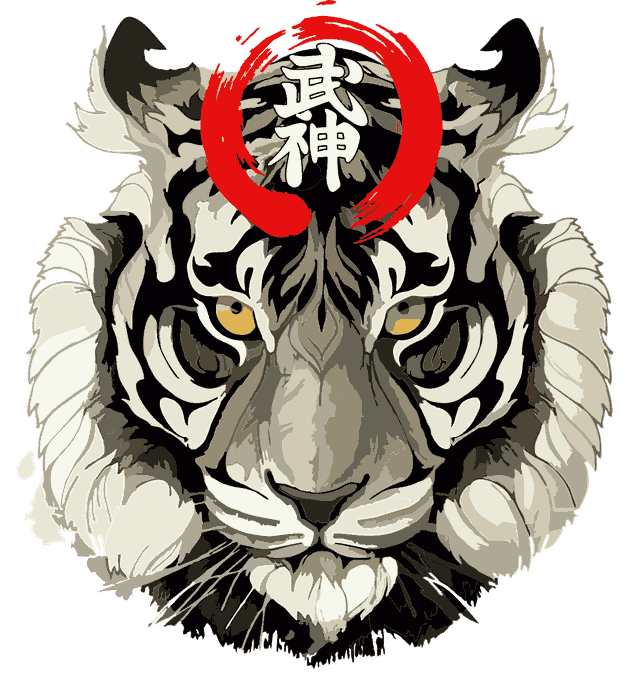
武神館武道体術Bujinkan Budo
Taijutsu
In short
Nine traditions,
taught as one.
The Bujinkan is not a style someone invented. It is nine separate Japanese ryūha — schools, each with its own scrolls, lineage and character — gathered under one roof by Soke Masaaki Hatsumi, who received them from his teacher Toshitsugu Takamatsu.
Six of them are bushi traditions, the martial arts of the samurai. Three are shinobi traditions, the arts of the ninja. The oldest are said to date to the twelfth century. What is trained today is the combined body of that material, called Budo Taijutsu — literally, the martial way of body technique.
There is no competition anywhere in it. No tournaments, no points, no weight classes. The training aims at protecting yourself and other people, which turns out to be a different problem from winning a match, and is solved differently.
The nine schools
The 九流派 — kyū ryūha.
| School | Meaning | Character of the school |
|---|---|---|
| Togakure-ryū Ninpō Taijutsu戸隠流忍法体術 | Hidden Door School | The ninpō tradition at the centre of the Bujinkan, traced to the twelfth century. Evasion, concealment, escaping a situation rather than meeting it. |
| Gyokko-ryū Kosshijutsu玉虎流骨指術 | Jewel Tiger School | Attacking soft tissue and nerve points with the fingers and thumbs. Circular movement, and the foundation most students meet first. |
| Kotō-ryū Koppōjutsu虎倒流骨法術 | Tiger Knocking Down School | Striking against the skeletal structure. Direct, linear, worked on forty-five degree angles. The counterpart to Gyokko-ryū's circles. |
| Shinden Fudō-ryū Dakentaijutsu神伝不動流打拳体術 | Immovable Heart School | Striking from wherever you happen to be standing. No formal stance, and traditionally trained outdoors using the ground and trees as they are. |
| Kukishinden-ryū Happō Bikenjutsu九鬼神伝流八法秘剣術 | Nine Demon Gods School | The weapons tradition — sword, staff, spear, halberd — and fighting in armour. Where most of the dojo's weapons work comes from. |
| Takagi Yōshin-ryū Jūtaijutsu高木揚心流柔体術 | High Tree, Raised Heart School | Grappling, throws, locks and controls. Close-quarters work developed for bodyguarding. |
| Gikan-ryū Koppōjutsu義鑑流骨法術 | Truth, Loyalty and Justice School | Bone-structure striking, with a distinctly ethical character. The rarest of the nine in general training. |
| Gyokushin-ryū Ninpō玉心流忍法 | Jewelled Heart School | Strategy, intelligence and espionage more than combat. The thinking side of the shinobi traditions. |
| Kumogakure-ryū Ninpō雲隠流忍法 | Hiding in the Clouds School | Survival, concealment and escape, including specialised tools and methods of moving unseen. |
Names, kanji and characterisations above follow the Bujinkan's own account of its lineages. As with most classical Japanese traditions, aspects of the early history are debated by historians outside the school.
Principles, not techniques
Why nine-hundred-year-old material still works.
The obvious objection is that nobody is coming at you with a naginata on the way home from Tesco. It is a fair objection, and the answer is that the techniques are the vehicle, not the destination.
Distance — 間合 ma-ai
Almost everything is decided by where you are standing before anything happens. Train it long enough and you stop being surprised by people arriving inside your space — in a car park, on a platform, in an argument that is escalating. Most trouble is avoided by distance, and distance is a habit.
Timing and initiative
Moving before rather than after. The sakki test is the extreme version of this, but the ordinary version is noticing the shift in someone's weight or voice a second earlier than you would have.
Balance — 崩し kuzushi
Taking someone's structure rather than overpowering it. This is why size and strength matter far less here than people expect, and why a smaller person can train seriously with a larger one.
Awareness — 残心 zanshin
Attention that continues after the immediate thing is dealt with. In training it means not dropping your guard when the technique finishes. Outside it, it is simply the difference between walking through the world and walking through it awake.
Not being there
Three of the nine schools are built around evasion, concealment and escape. That is the part people miss when they picture ninjutsu. The most sophisticated answer to a threat is usually to have already left, and the tradition takes that seriously rather than treating it as cowardice.
What this is not
It is not a six-week self-defence course, and it is not a competitive sport. If you want to test yourself against a resisting opponent under rules on a Saturday, judo or BJJ will serve you better and we would say so.
What this offers instead is a deep body of material you can still be learning from in thirty years, trained at a pace that does not wreck your joints along the way.
Who it suits
Teenagers, parents, and people starting late.
Teenagers
From twelve, young people train in the adult class. They get a room where nobody is shouting, where progress is individual, and where adults treat them as training partners rather than as children. That is often the thing that lands hardest.
Self-defence, honestly framed
Awareness, distance and the confidence not to escalate will keep you out of far more trouble than any technique. Those are trained here directly, and they are the parts that actually transfer.
Parents training alongside
Several of our students train with their own teenager. It is a rare thing to be a beginner at something together, and it changes the relationship in ways people don't anticipate.
Starting in your forties or fifties
Taijutsu is built on efficient movement rather than speed and power, which is exactly why people can still train seriously decades in. You will not be asked to keep up with a twenty-year-old.
Body and mind together
The physical work is real — mobility, core strength, coordination. The mental work is inseparable from it: patience, composure under pressure, and paying attention on purpose.
Something older than you
There is a quiet, non-religious dimension to training in a tradition this old — bowing into a room, keeping etiquette, working on something that will outlast you. Take from it what you find useful.
The community
A small dojo
in a large family.
Hereford is a small club and that is deliberate — you will be taught personally, by name, every session. But the Bujinkan itself is worldwide, with dojos across Europe, the Americas and Asia, and its head school in Noda, Japan.
That has a practical consequence. Training here is not local currency. A Bujinkan grade means the same thing in Barcelona, Buenos Aires or Tokyo, and students who travel can walk into a dojo anywhere and be received. Our own instructor's students in Catalonia now run their own clubs.
The dojo hosts an annual seminar and takes part in others across the UK and abroad. Seminars are where you meet the wider organisation, train under instructors other than your own, and discover how large the thing you have joined actually is.
First class free
Reading about it only goes so far.
Adults and young people from 12 train Monday and Thursday, 7.00–8.30pm, at Steiner Academy Hereford.
Book a trial class